Presented by Hanna Chaudhry, LMSW — therapist specializing in anxiety, depression, OCD, ADHD, grief, trauma, workplace stress, identity exploration, and relationship challenges with an approach grounded in empathy and empowerment.
This article is written with mental health and healthcare providers in mind. If you’re not a provider, you’re still welcome to read along; just know the content is tailored to a clinical perspective.
Your patient shares that they have an interview for a life-changing job lined up. It’s not for another week, yet their anxiety has already started. They describe scattered thoughts, tense muscles, a persistent sense of dread, and trouble falling asleep.
When reframed through the lens of sports psychology, that patient resembles an athlete preparing to compete. The setting may be different, but the challenge is familiar — managing stress, staying focused, and performing when the pressure is on.
Sports psychology examines how thoughts, emotions, and behavior affect performance, and conversely, how sports and exercise affect mental health.
Hanna Chaudhry, LMSW, recently led a presentation for Rivia Mind providers on the mental health benefits of sports, the psychological pressures athletes face, and the techniques sports psychologists use to help athletes perform. Many of the skills developed in the field apply beyond athletics, and the discussion explored how those same techniques can support patients navigating anxiety, stress, self-doubt, and other challenges in everyday life.
The Mental Health Benefits of Sports
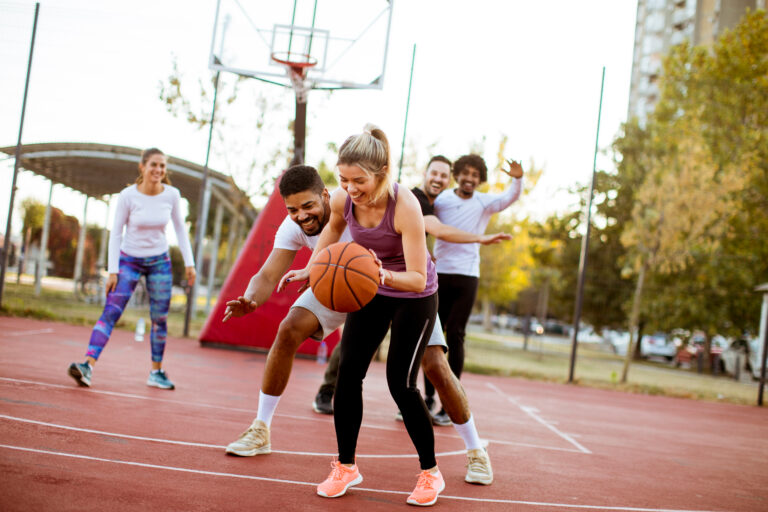
The case for movement starts with mood. Adults who play sports report higher self-esteem and life satisfaction, lower stress, anxiety, and depression, and a stronger sense of belonging. They also note stronger self-control and communication skills, with even more potent and additional benefits emerging when team sports are involved.1
Exercise has also been studied in relation to depression. In one trial, aerobic exercise eased major depression nearly as well as sertraline.2 The study offered an interesting look at the potential role of exercise in treatment rather than suggesting exercise and antidepressants are interchangeable.
Several processes appear to drive those gains. Endorphins usually get the credit, but exercise also affects neuroplasticity, inflammation, and stress hormones, along with norepinephrine, a chemical tied to the stress response.3
Sleep is another important piece of the connection. Regular physical activity can improve sleep quality and help people fall asleep faster and spend more of the night actually asleep.4 Exercise can also affect the body’s circadian rhythm, with the timing of the workout influencing the direction of that effect.5 For patients whose mood and functioning deteriorate after several poor nights of sleep, improving physical activity may be one part of a broader approach to better sleep.
Exercise may affect the brain itself, too. In animal research, running increased the number of new neurons that survived in the hippocampus of mice. In a study of older adults, one year of aerobic exercise increased hippocampal volume by about 2%, offsetting roughly one to two years of typical age-related volume loss.6,7
Taken together, the research suggests that the benefits of exercise and sports extend beyond the physical, influencing mood, stress regulation, sleep, social connection, and brain health through several pathways at once.
The Pressures Athletes Face
Sports and mental health don’t always go hand in hand. The same arena that supports well-being can also strain it — elite athletes report more psychological distress than the general population, and several conditions come up often in their care.1
ADHD appears more often in some sports, with an estimated 7% to 8% of student and elite athletes affected.8 “Athletes with ADHD might thrive in high-stimulation and fast-paced environments like sports and performance, but they may struggle with aspects of daily life like school, work, or relationships,” Chaudhry explains.
Depression and anxiety are about as common among athletes as in the general population, but stigma in sports culture keeps many from seeking help, and young athletes often worry about what their coaches would think.9 About half of college varsity athletes report overwhelming anxiety, yet only a quarter of them report a diagnosis or treatment.10
Other risks are specific to sport. Overtraining syndrome, which develops when training outpaces recovery, brings fatigue, declining performance, and mood changes that can take months to resolve.11 Eating disorders are also more common in weight-sensitive sports such as endurance, weight-category, and aesthetic events.12
Sprinter Noah Lyles named his own diagnoses in a post after winning Olympic gold in 2024, listing asthma, allergies, dyslexia, ADD, anxiety, and depression and adding that “what you have does not define what you can become.”13
For Chaudhry, stories like Lyles’s highlight an important point: athletic ability and mental health challenges can exist side by side. “These struggles and these mental health challenges might be a lot more common among athletes than we think,” Chaudhry says.
What Sports Psychology Brings to Therapy
Sports psychology has studied the mind’s role in performance for well over a century, since cyclists were found to ride faster against competitors than against the clock in 1898.14 By 1925, Coleman Griffith had opened an athletic research laboratory at the University of Illinois, work that earned him recognition as the father of American sport psychology.15
Today the field includes educational specialists who focus on performance enhancement using techniques like goal setting and imagery, clinical specialists who treat depression and anxiety alongside performance concerns, and exercise psychologists who help non-athletes build lasting habits, often through mindfulness and motivational interviewing.
Its reach extends well past elite sport. The tools “that we can learn from sports psychology as a whole, I think, can be beneficial to all clinicians,” Chaudhry says.
As sports psychologist Dr. Wendy Borlabi put it, an athlete’s inner game matters as much as the outer one. The techniques that follow work on both.
Calming the Body Before High-Pressure Moments
Athletes perform best when they are alert without tipping into panic, and sports psychologists help them reach that state through arousal regulation. It’s been described as finding the right “emotional temperature.”
Deep breathing, meditation, and progressive muscle relaxation bring arousal down. Biofeedback adds real-time readings of heart rate and muscle tension so people can see their stress response and learn to steer it, an approach linked to reductions in stress and anxiety.16
“This can be really useful for treating patients who are dealing with panic attacks, chronic stress and anxiety, or just any sort of emotional dysregulation,” Chaudhry says.
Progressive muscle relaxation, the practice of tensing and then releasing muscle groups, teaches people to tell tension from relaxation. Athletes use it to settle before competition. With patients, it can ease muscle tension, help lower blood pressure, and fit well alongside CBT for generalized anxiety.17
Environment also matters. Athletes adjust lighting and temperature in their training spaces to protect focus, and clinicians can help patients set up calmer spaces at home or work in the same way.
Training the Inner Game
Athletes also have to manage what happens in their heads. Thoughts like “I’m not good enough” or “I’ll never be able to win” wear down confidence, and sports psychologists help athletes replace them with statements such as “I’ve prepared and trained for this moment.” Structured self-talk training measurably improves performance.18
CBT, the most widely used approach in sports psychology, does the deeper work. A clinician helps the athlete who thinks “I’m going to fail” land on something more grounded, like “I might feel nervous, but I’m prepared for it,” while learning to spot catastrophizing and black-and-white thinking.
Pre-performance routines give preparation a shape. A few minutes of specific music, breathing, or cue words signal that the body and mind are ready, and these routines improve performance even under pressure.19 The same principle can work for everyday high-pressure moments. A patient preparing for a presentation, difficult conversation, interview, or first date might benefit from creating a short routine that signals, “I’m ready.”
Imagery and visualization take rehearsal a step further. Athletes review past performances and picture success in vivid physical and emotional detail, from the winning shot to the feeling that follows it. That familiarity eases anxiety before the real event.
Building Mental Toughness and Setting Goals
Mental toughness, the ability to stay focused and composed under pressure, can be fostered. This quality is a critical factor for both emotional well-being and behavioral resilience. It grows in environments that feel supportive and challenging at once and around people who offer encouragement and honest feedback, like coaches, teammates, and mentors. It also builds through reflective learning, such as getting into the habit of asking after any performance, “What could I do differently next time?”
Goals give that growth a direction. Clear, meaningful goals lead to better performance than a vague intention to do one’s best.20 For an athlete, that can be something like training for a specialized skill or trying to beat a personal best. For patients who arrive overwhelmed, they offer a place to begin to break down bigger challenges into manageable steps.
“Goal setting is a very important place to start the process, because it helps make things a little more approachable,” Chaudhry offers. “Combined with the process of building mental toughness, it can really encourage patients to move toward growth.”
One sports psychologist frames success as the sum of consistent actions rather than the size of any single effort, a useful message for patients who feel stuck.
Seeing Patients as Performers in Their Own Lives
The idea that ties these tools together is performance-based therapy. “There’s something valuable that can come out of viewing our patients as performers in their own lives,” Chaudhry says. They perform at work and at school, in their relationships, and for the people who rely on them, all while managing their mental health. “Our role as clinicians is to help patients perform their best at an emotional, mental, and behavioral level, whatever that looks like in their unique context,” she adds. That means equipping them with tools and techniques that build self-awareness, confidence, and resilience.
By developing mental toughness alongside goal setting, we offer patients a framework that helps them learn how to stay more emotionally regulated and grounded in the face of adversity. And by building their ability to tolerate discomfort, we help them handle setbacks while staying committed to their goals.
For the patient dreading the big interview, their plan might include a pre-performance routine to calm the body, a quieter environment with fewer distractions, and CBT skills to challenge the self-doubt that surfaces beforehand.
Bringing Sports Psychology Into Mental Health Care
Sports psychology for athletes offers a useful reminder to us all: mental health isn’t just about reducing symptoms, but also about helping people function, adapt, and show up strong.
Athletes learn to manage pressure, face adversity, work with self-doubt, and stay focused when emotions run high. Those same skills can help patients return to work after burnout, manage anxiety before an important conversation, or build momentum toward a goal.
For clinicians, that creates opportunities to look beyond what’s going wrong and ask what a patient is trying to do, what gets in the way, and which strengths they can build on. Sports psychology doesn’t replace evidence-based mental health treatment, but its focus on preparation, self-awareness, regulation, and purposeful action complements it.
The mental health benefits of playing sports might be the conversation starter — but the end game is to give patients the tools to participate more fully in their own lives.
If you’re looking for a mental health partner for your patients, Rivia Mind’s psychiatric and therapy providers can help. Contact us to get started or learn more about referring.
References:
- Eather, N., Wade, L., Pankowiak, A., & Eime, R. (2023). The impact of sports participation on mental health and social outcomes in adults: a systematic review and the ‘Mental Health through Sport’ conceptual model. Systematic reviews, 12(1), 102. https://doi.org/10.1186/s13643-023-02264-8
- Blumenthal, J. A., Babyak, M. A., Doraiswamy, P. M., Watkins, L., Hoffman, B. M., Barbour, K. A., Herman, S., Craighead, W. E., Brosse, A. L., Waugh, R., Hinderliter, A., & Sherwood, A. (2007). Exercise and pharmacotherapy in the treatment of major depressive disorder. Psychosomatic medicine, 69(7), 587–596. https://doi.org/10.1097/PSY.0b013e318148c19a
- Nowacka-Chmielewska, M., Grabowska, K., Grabowski, M., Meybohm, P., Burek, M., & Małecki, A. (2022). Running from Stress: Neurobiological Mechanisms of Exercise-Induced Stress Resilience. International journal of molecular sciences, 23(21), 13348. https://doi.org/10.3390/ijms232113348
- Kredlow, M.A., Capozzoli, M.C., Hearon, B.A. et al. The effects of physical activity on sleep: a meta-analytic review. J Behav Med 38, 427–449 (2015). https://doi.org/10.1007/s10865-015-9617-6
- Youngstedt, S. D., Elliott, J. A., & Kripke, D. F. (2019). Human circadian phase-response curves for exercise. The Journal of physiology, 597(8), 2253–2268. https://doi.org/10.1113/JP276943
- van Praag H, Kempermann G, Gage FH. Running increases cell proliferation and neurogenesis in the adult mouse dentate gyrus. Nat Neurosci. 1999 Mar;2(3):266-70. doi: 10.1038/6368. PMID: 10195220.
- K.I. Erickson, M.W. Voss, R.S. Prakash, C. Basak, A. Szabo, L. Chaddock, J.S. Kim, S. Heo, H. Alves, S.M. White, T.R. Wojcicki, E. Mailey, V.J. Vieira, S.A. Martin, B.D. Pence, J.A. Woods, E. McAuley, & A.F. Kramer, Exercise training increases size of hippocampus and improves memory, Proc. Natl. Acad. Sci. U.S.A. 108 (7) 3017-3022, https://doi.org/10.1073/pnas.1015950108 (2011).
- Han DH, McDuff D, Thompson D, et alAttention-deficit/hyperactivity disorder in elite athletes: a narrative review. British Journal of Sports Medicine 2019;53:741-745.
- Gulliver, A., Griffiths, K. M., & Christensen, H. (2012). Barriers and facilitators to mental health help-seeking for young elite athletes: a qualitative study. BMC psychiatry, 12, 157. https://doi.org/10.1186/1471-244X-12-157
- Factors affecting anxiety-related symptoms, diagnosis, and treatment among college student-athletes in the National College Health Assessment. Journal of Athletic Training. 2023.
- Meeusen R, Duclos M, Foster C, Fry A, Gleeson M, Nieman D, Raglin J, Rietjens G, Steinacker J, Urhausen A; European College of Sport Science; American College of Sports Medicine. Prevention, diagnosis, and treatment of the overtraining syndrome: joint consensus statement of the European College of Sport Science and the American College of Sports Medicine. Med Sci Sports Exerc. 2013 Jan;45(1):186-205. doi: 10.1249/MSS.0b013e318279a10a. PMID: 23247672.
- Currie A. (2010). Sport and eating disorders – understanding and managing the risks. Asian journal of sports medicine, 1(2), 63–68. https://doi.org/10.5812/asjsm.34864
- Olympics.com. Paris 2024 athletics: Team USA’s Noah Lyles shares brave and inspiring message after winning 100m Olympic gold.
- Triplett N. The dynamogenic factors in pacemaking and competition. American Journal of Psychology. 1898;9:507–533. Reproduced in Classics in the History of Psychology, York University.
- Introduction to sport psychology (sample chapter 1). Routledge. ISBN 9781848729780.
- Goessl, V. C., Curtiss, J. E., & Hofmann, S. G. (2017). The effect of heart rate variability biofeedback training on stress and anxiety: a meta-analysis. Psychological Medicine, 47(15), 2578–2586. doi:10.1017/S0033291717001003
- National Center for Complementary and Integrative Health. Relaxation techniques.
- Hatzigeorgiadis, A., Zourbanos, N., Galanis, E., & Theodorakis, Y. (2011). Self-Talk and Sports Performance: A Meta-Analysis: A Meta-Analysis. Perspectives on Psychological Science, 6(4), 348-356. https://doi.org/10.1177/1745691611413136
- Rupprecht AGO, Tran US, Gröpel P. The effectiveness of pre-performance routines in sports: a meta-analysis. International Review of Sport and Exercise Psychology.
- Locke EA, Latham GP. Building a practically useful theory of goal setting and task motivation: a 35-year odyssey. American Psychologist.