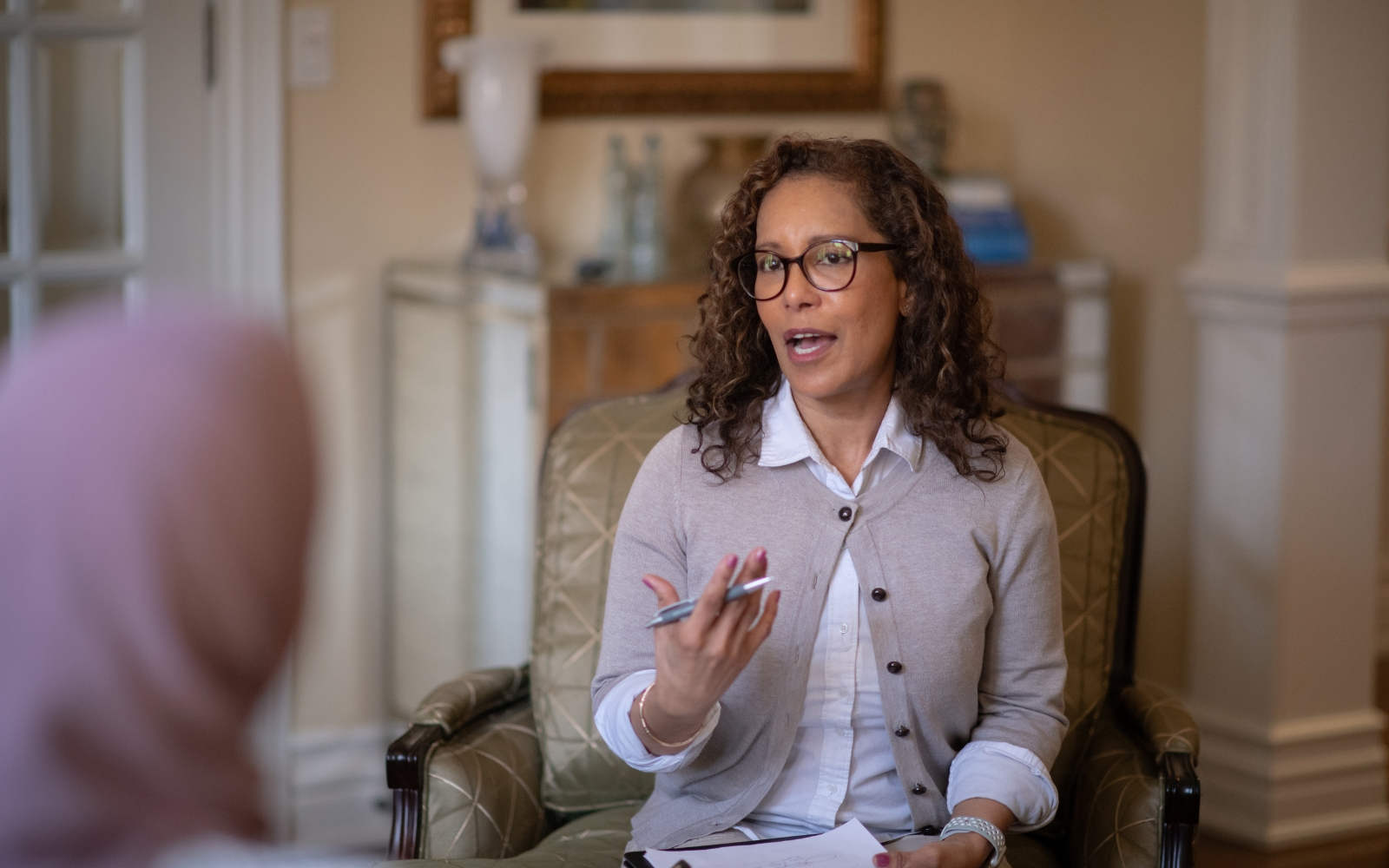
Presented by Erin Jackson, LCSW — Licensed Clinical Social Worker specializing in trauma-informed mental health care.
This article is written with mental health and healthcare providers in mind. If you’re not a provider, you’re still welcome to read along; just know the content is tailored to a clinical perspective.
What does trauma-informed care look like in practice? We sat down with Rivia Mind clinician Erin Jackson, LCSW, to find out. What follows is a conversation about how she reads a room, builds safety with patients, and holds cultural complexity alongside clinical acuity.
How would you describe trauma-informed care in your own words?
Trauma-informed care means not just paying attention to symptoms, but to the experiences of the person sitting in front of me. Instead of asking What’s wrong with you?, we ask something like: What happened to you — and how did you survive it?
It’s essentially care that treats people with dignity and respects their pace. If someone comes to therapy having experienced trauma, it’s really important that we align with their level of comfort and let them disclose what feels right and when — making sure patients feel safe and not pressured to reveal everything all at once.
When you’re meeting someone for the first time and know they have a significant trauma history, how do you approach that initial session?
I do a lot of tone-setting. I’ll walk through what therapy looks like, be as transparent as I can about the process, and make clear that the patient is in the driver’s seat — they set the pace for the conversation.
My job in that first session is to be present and actively listen more than I interpret, while ensuring the patient feels heard as opposed to analyzed.
Not every patient arrives knowing they’re carrying trauma. What might you pick up on that signals something unresolved?
A lot of it is nonverbal communication. I’m watching for whether someone is fidgety, whether their speech appears pressured or unusually slow, whether there’s a tendency toward thought-blocking, or trepidation about engaging on certain subjects. Those are definitely signs.
It also stands out when someone presents as very well put together and organized, yet there’s still an unexplained element underneath. A patient who seems to have difficulty relaxing or is hiding that they’re in a state of distress or overwhelm. Something in their life has caused their behavior to be so intact.
When anxiety or depression is in the picture alongside trauma, how does that change your approach?
Those symptoms are information. We treat them as something deeper that’s happening. A patient may present as anxious, and that anxiety is actually a protective mechanism that keeps them safe. Or they might present with depression, and that depression could be reflecting emotional exhaustion, or unresolved guilt and shame.
It’s important to see depression and anxiety not as conditions to eliminate, but as a sign that something is going on below the surface. That adds another layer of inquiry and support when exploring those avenues to help someone be less triggered by their trauma.
How does cultural awareness fit into trauma-informed care?
Cultural awareness is essential for a clinician in general. But when we’re talking about individuals who have suffered from trauma, it’s really important to recognize that people’s experiences don’t happen in isolation from their identity or environment.
Many intersections come into us as individuals, specifically from a cultural standpoint. We have to be aware of the historical context that may influence how people respond to certain things, look at gender roles and how those impact how people interact within trauma, and recognize that certain cultures carry stigmas around expressing or talking about mental health.
A big piece is simply being curious and always willing to take the extra step to understand. Cultural awareness also means recognizing generational resilience as well as generational trauma — realizing that strength can be a survival strategy, and independence can come out of necessity. It means avoiding assumptions and allowing each person to define their own experience and identity.
What does it take to build psychological safety with patients who’ve experienced trauma?
I think it starts with how we show up. Having all the training we have definitely matters. But there’s a lot of value in just being your authentic self. People can read through things that aren’t natural. It’s also necessary to recognize when we don’t have all the answers or need to do more research. Being genuine and allowing vulnerability allows the patient to relax into the process as we help them sit with and hold heavy things.
As we’re assessing our patients, they’re assessing us — making sure they have a safe space. So being transparent, honest, and forthright about who we are, what our styles are, and how we want to create space for them is very important. Having humility is huge. As is doing a lot of active listening. Being willing to say things like help me understand that better or tell me more about that communicates that we’re listening, we’re open, and we have real respect. The hope is that over time, safety develops through that consistency and consideration.
What would you say to a patient preparing for their first therapy session who’s nervous about starting?
That’s a natural response. Therapy requires us to really look at ourselves beyond a surface-level lens — our patterns, our environments — and make some real determinations about how we want to live our lives. Sometimes confronting ourselves or our situations can be very scary. And also, it can be very healing.
I would validate the fear and offer understanding of it. And I would also say: even within the fear, this space is safe. Setting goals for what we want to get out of this is going to be huge. We’ll bring up hard stuff, exploring the depths of who we are as individuals, and collaborating on ways to move forward. That’s going to require really tough, sometimes burdensome, intrinsic work. But the goal is to leave just a little lighter than when you came in.
Rivia Mind is committed to providing confidential, evidence-based care that honors each individual’s full story. To refer a patient or learn more about our trauma-informed approach, call our Referral Intake Specialist at (929) 295-4879 or email referrals@riviamind.com.